sorry for the late upload…
In this time, law and
science were very false, or very different from what we know today. Scientists,
writers and film creators believed African Americans were inferior, diseased in
some cases and a false evolution of the race. Now we know that it is just a
gene pigment of a difference. However, this previous belief fits into the film
creators’ discourse community. It wasn’t hard for these writers and film
makers, politicians and Northern families to put this image of the blacks out
there for the public because others in their community already had their same
belief. The Birth of a Nation was no different in these beliefs and it
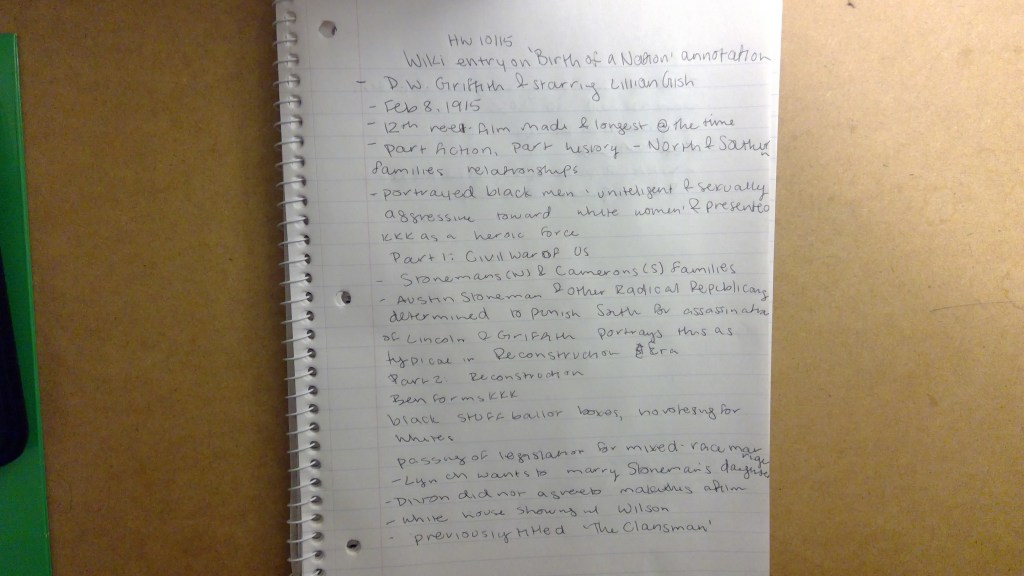
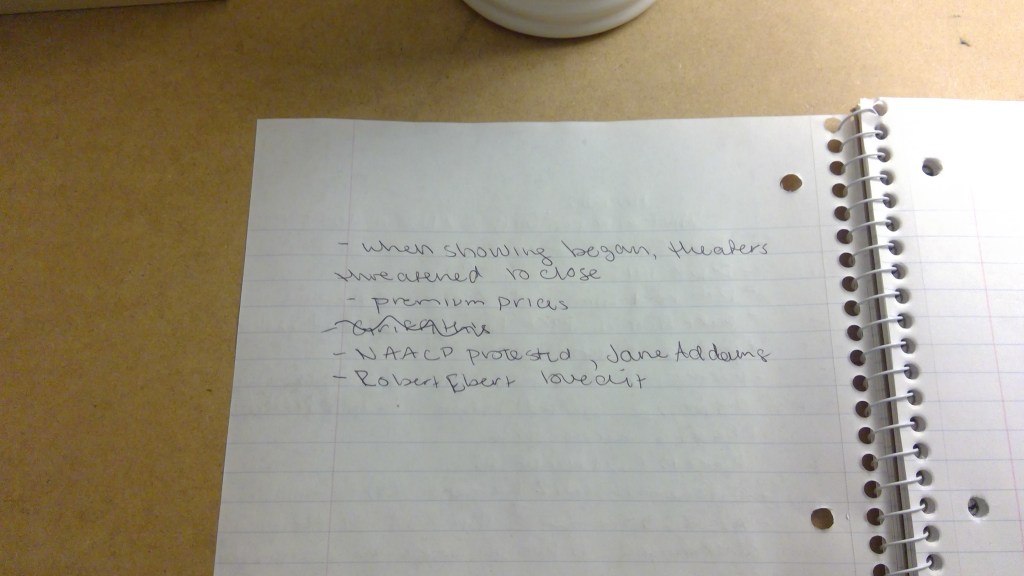
became the most popular, pure and raw film in 1915. The film was primarily produced
by D.W. Griffith, nicknamed “father of racist cinema”. It capitalized on the Ku
Klux Klan, Lincoln’s assassination, and two families in the North and South.
This film was also the first to use complex techniques never before seen such
as fade out, cross cutting, close-ups, extra cast and even an intermission.
In assignment one, I analyzed Morgan’s, The Race Question. Morgan worked
to further set the belief into his readers that if blacks were to get more
freedom, such as the right to vote, they would become too educated and smart. This
newfound freedom for African Americans, he believed would then mean whites lose
superiority and African Americans would take vengeance with their new freedoms.
Morgan, as well as many of his colleagues, worked to instill fear into his
readers. Griffith, in Birth of a Nation about two decades later, uses
the same discourse belief via film. Griffith takes these preexisting ideas into
his film and uses a straightforward storytelling method, being precise in how
and when the characters are seen by his audience. John Tyler Morgan and
Griffith are alike in more ways than one. In both pieces, Griffith and Morgan build
on their discourse community’s idea that blacks will always be inferior, we should
fear them and elaborate on the different outcomes of blacks having power and
rights.
To paraphrase Hoffman, in his
writing he states that when you mate two races, you get anger, violence and
different sexuality. Griffith builds on this preexisting idea. Because this idea
already exists, Griffith just has to hint towards it and the audience will
understand. Such as when Lydia, Stoneman’s maid begins talking to the rich,
white, strong man. Griffith can easily assume his audience knows this is wrong.
At the time, it was believed black and white people did not have relations. Lydia
clearly shows in her facials in the film that she knows her seeing this man is
wrong. Griffith produces the scene a different level of visual by showing Lydia
bending down to pick up a hat, trying to seduce the man by ripping her clothes
and showing an inappropriate amount of skin and breaking the fourth wall to the
audience by making eye contact. Lydia becomes shy and flirty and seeking for Silas
to protect her. White men at the time, were viewed as rich, white and strong.
Both producers, Morgan and
Griffith, used emotional appeal to their audience. Morgan used his writing fear
of blacks gaining new freedoms and whites becoming inferior to scare his
audience. While Griffith also used his screen to instill fear and terror and
get a reaction of his audience. Griffith made the audience feel like they were
watching something bad between the mixed women and white man. He made it obvious
how much time he spent working on the characters’ parts, costumes, and
emotional language before putting anything out into his discourse community. It
was Birth of a Nation that inspired the Ku Klux Klan to continue because
blacks were seen as dangerous.
In my opinion, Griffith did a
better job at portraying the same message via film that Morgan wrote about 25
years prior. I think Griffith used a lot more techniques to get his message
across way more bluntly. Morgan danced around the topic and doesn’t obviously
use characters to say what he needs to for him. After all, Birth of a Nation
is a widely popular film that many discourse communities and public eye caught sight
of. Overall, Griffith did a more exciting piece on the race segregation in
American in the early 1900s.
 Alexis' Blog